Introduction
Most “token creator” sites are a mint button with a logo. You click, you pay gas, and you leave — usually without understanding what you just deployed.
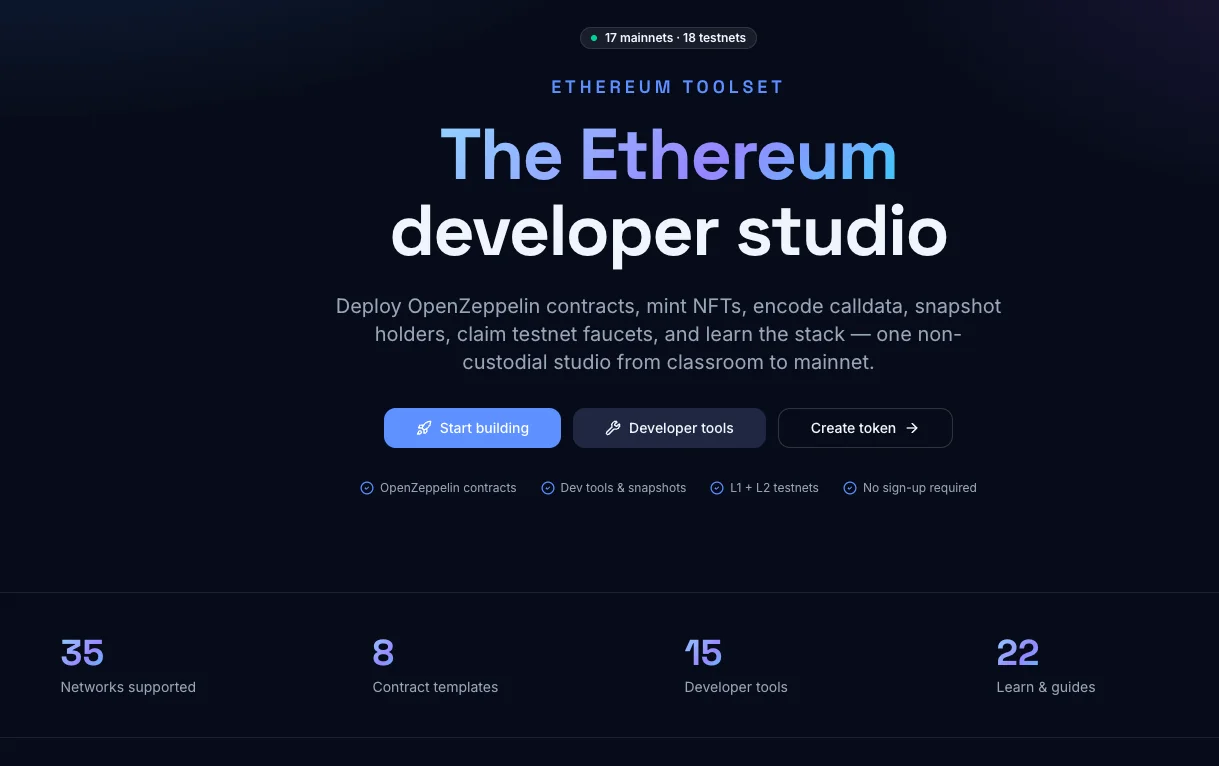
Ethereum Toolset (ethereumtoolset.com) is built differently. It is a non-custodial Ethereum developer studio: deploy OpenZeppelin contracts from your wallet, then stay in the same product for ABI tools, holder snapshots, faucets, bulk airdrops, dashboards, and learn/guides.
The product promise is simple and accurate:
Deploy OpenZeppelin contracts, mint NFTs, encode calldata, snapshot holders, claim testnet faucets, and learn the stack — one non-custodial studio from classroom to mainnet.
The flow is three steps: connect wallet → configure / review Solidity → sign. No signup. No custodial accounts. Keys never leave the wallet.
This article is a builder’s walkthrough of what Ethereum Toolset actually is, who it is for, and why the trust model matters if you care about shipping real ERC-20, NFT, and DAO systems on Web3 without treating Solidity as a black box.
Problem Statement
Founders, students, and operators keep hitting the same gaps:
- Mint buttons hide the contract. You deploy something, but you never see the source, the extensions, or the constructor arguments that matter later.
- Tooling is fragmented. One site for tokens, another for NFT metadata, another for Merkle trees, another for faucets, another for docs — and none of them share a workflow.
- Ops starts after deploy. Airdrops need holder CSVs. Bulk transfers need reviewable recipient lists and downloadable reports. Most mint UIs abandon you right when the real work begins.
- Classrooms need testnets, not mainnet theater. Students need Sepolia / Amoy / L2 sepolias, curated faucets, and guided paths — not a production-only form.
- “No-code” often means “no audit trail.” If you cannot review Solidity before you sign, you cannot responsibly ship.
Generic token factories solve the first click. They do not solve the studio problem: deploy, verify, manage, educate, and operate in one place.
Solution
Ethereum Toolset treats deploy as the beginning of a studio session, not the end of a form.
Token Creator
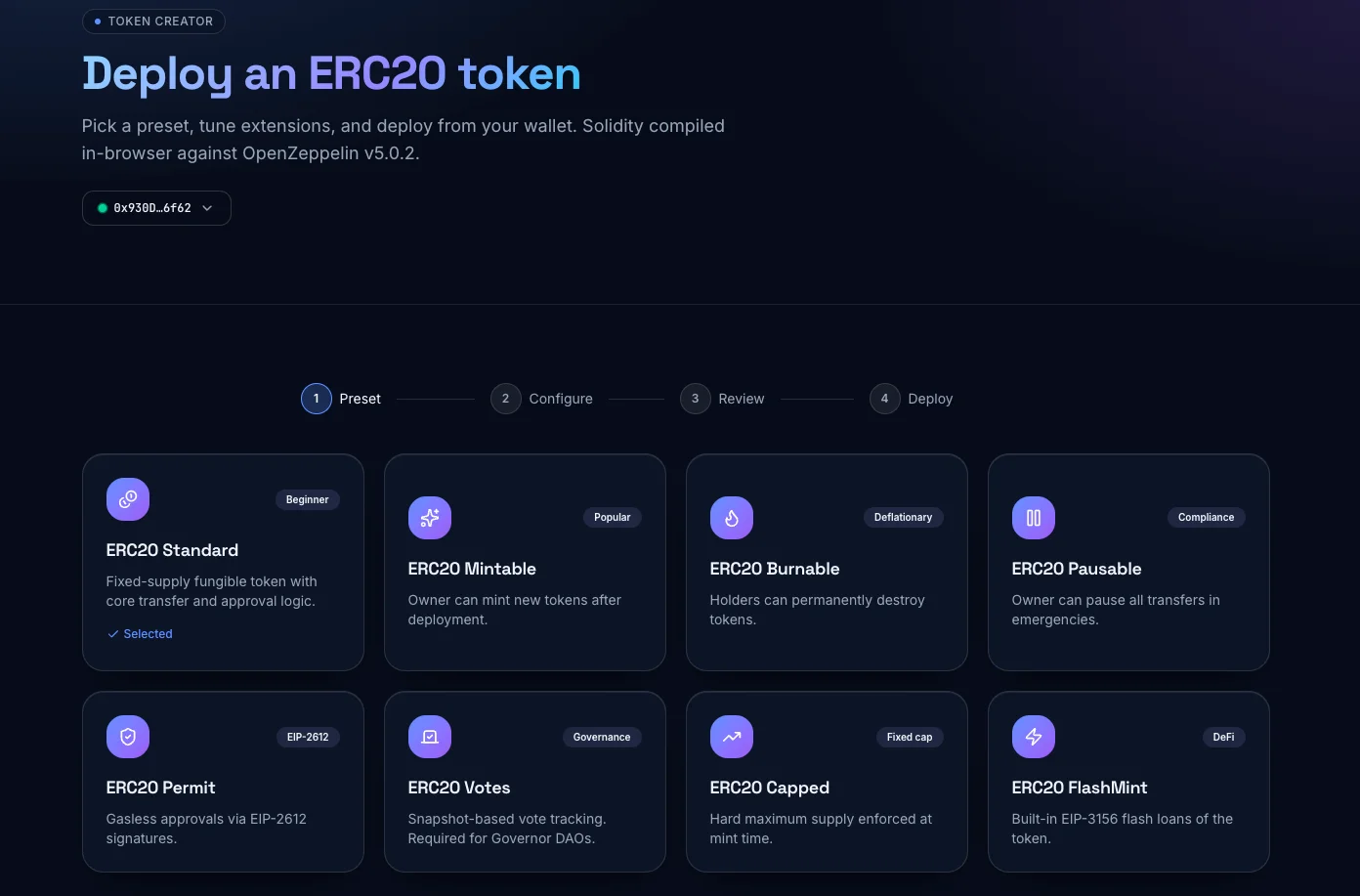
On /token-creator, you deploy ERC-20s with real OpenZeppelin-style presets: Standard, Mintable, Burnable, Pausable, Permit (EIP-2612), Votes, Capped, and FlashMint. Mix extensions, set name / symbol / supply / owner / cap, review the live Solidity, compile in the browser (solc 0.8.24 in a Web Worker), deploy from your wallet, verify, and keep a local history.
NFT Creator + Mint Asset
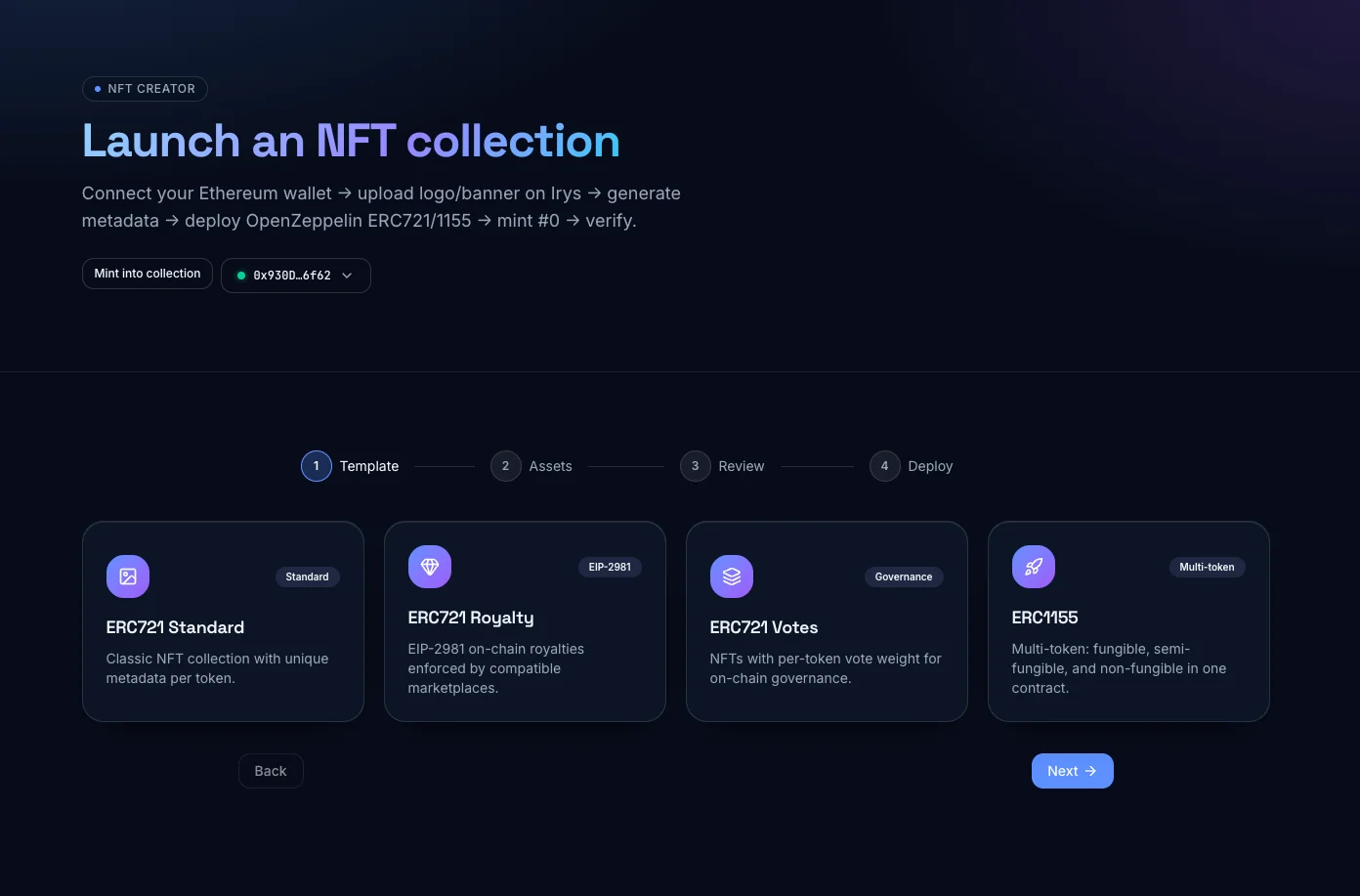
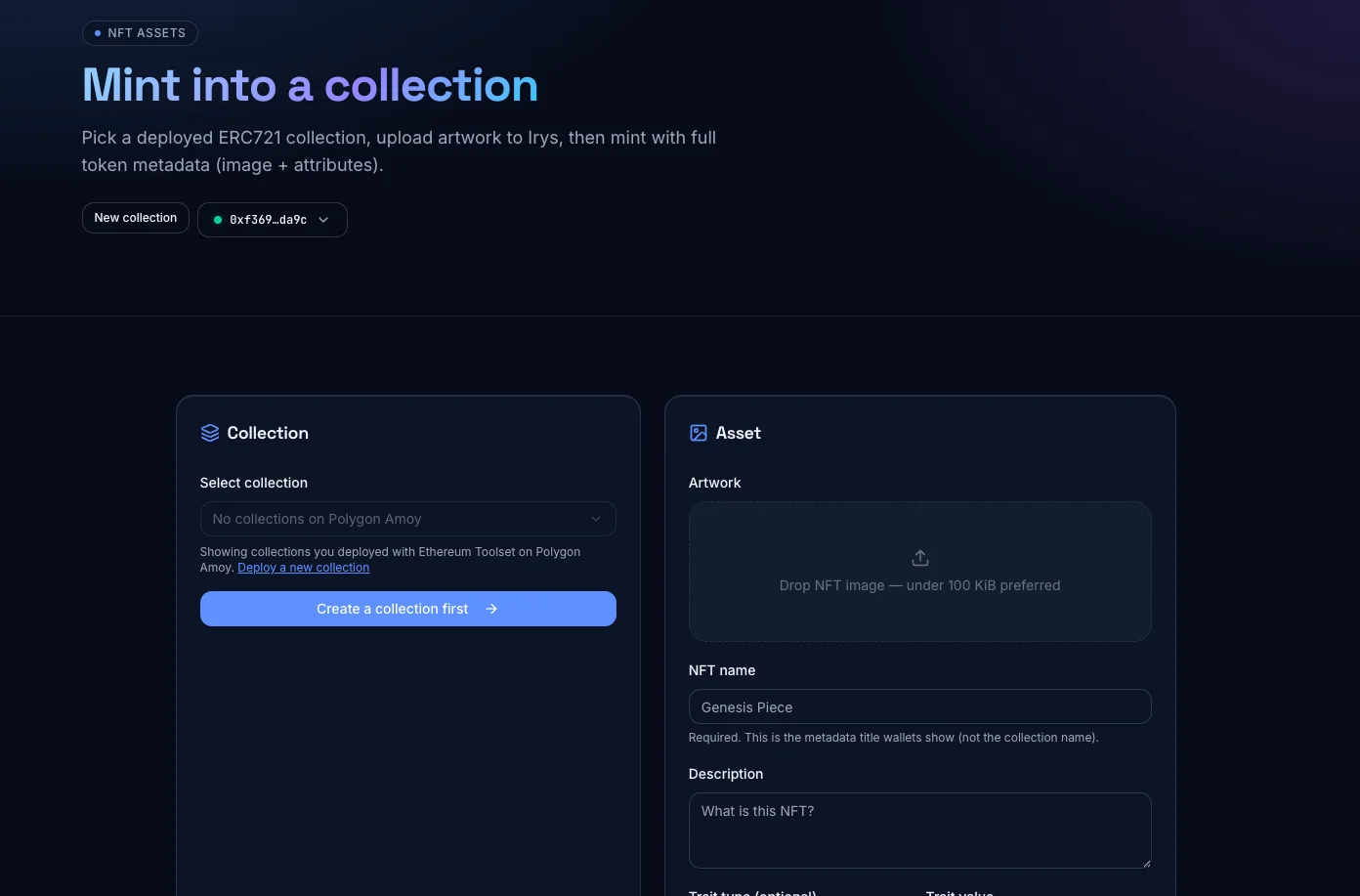
/nft-creator supports ERC721 (Standard / Royalty EIP-2981 / Votes) or ERC1155. Logos, banners, and metadata go to Irys; then you deploy and mint #0. /nft-asset mints more into an existing collection with art + metadata on Irys → safeMint.
Accuracy note for builders: marketing sometimes says “IPFS”; the implementation uses Irys (files under ~100 KiB can upload free).
Contract Wizard (8 templates)
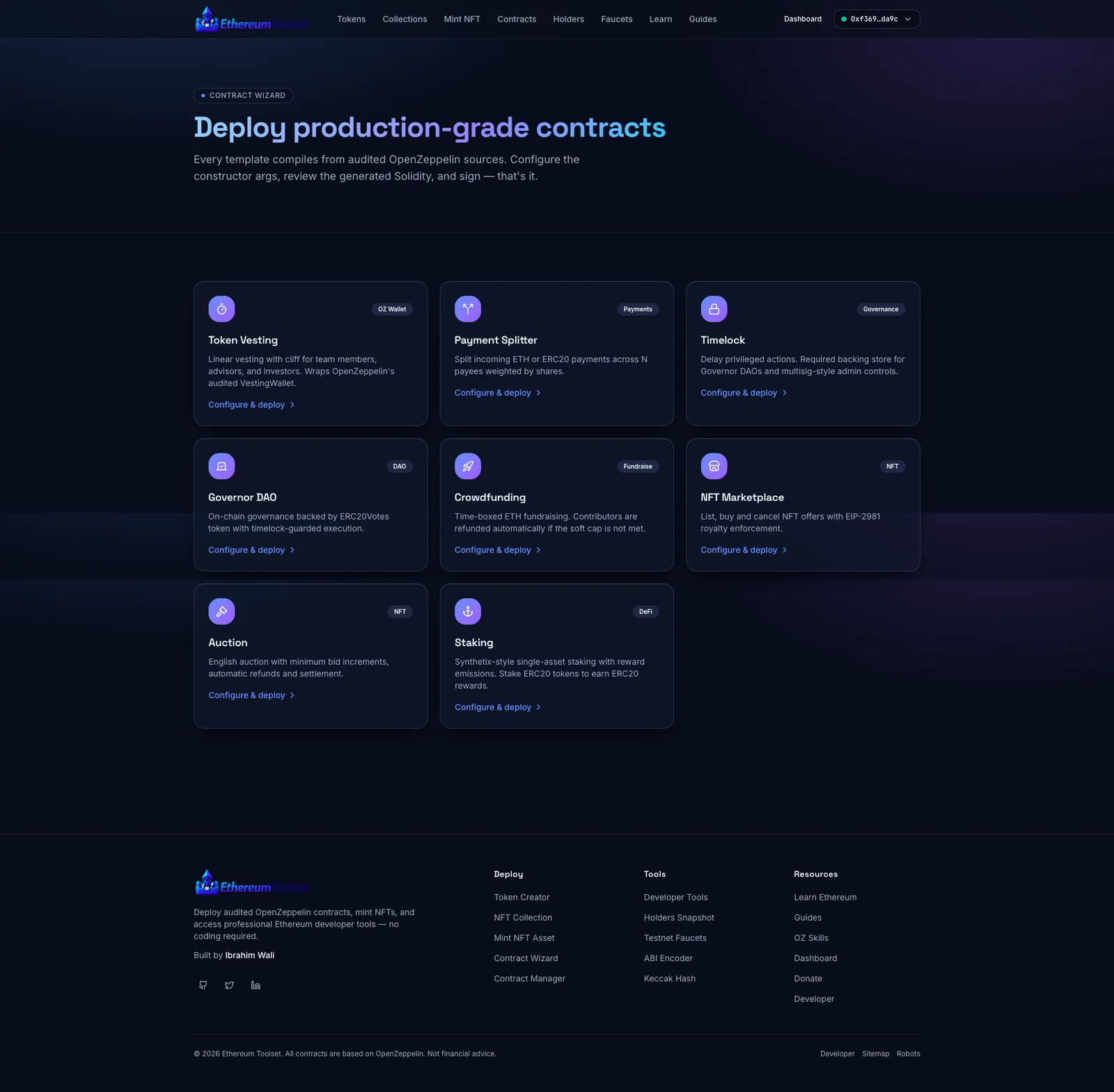
Beyond tokens and NFTs, the Contract Wizard covers Vesting, Payment Splitter, Timelock, Governor DAO, Crowdfunding, NFT Marketplace, Auction, and Staking. Configure constructor args → review OZ-based Solidity → deploy.
Developer tools (14)
Browser utilities that belong next to deploy wizards, not in a separate bookmark folder:
- Tokens: Bulk Token Transfer
- Encoding: ABI Encoder/Decoder, Event Decoder, Calldata Decoder
- Hashing: Function Selector, Keccak-256, SHA-256
- Math: Unit Converter, CREATE2 Calculator
- Utilities: Address Validator, Timestamp Converter, Gas Estimator
- Merkle: Tree
- Proof generators for airdrops and allowlists
Bulk transfers and holder snapshots
Paste comma-separated recipients + amounts, review the list, then sign. Batch mode can send ≤50 transfers per transaction (one-time BulkTokenSender helper + approve), or one tx per row. Reports export to CSV / Excel / PDF — airdrop ops without a spreadsheet nightmare.
/holders rebuilds ERC-20 balances or ERC-721 owners from Transfer logs across supported chains and exports CSV / JSON / TXT for airdrops and class labs.
Faucets, dashboard, and follow-through
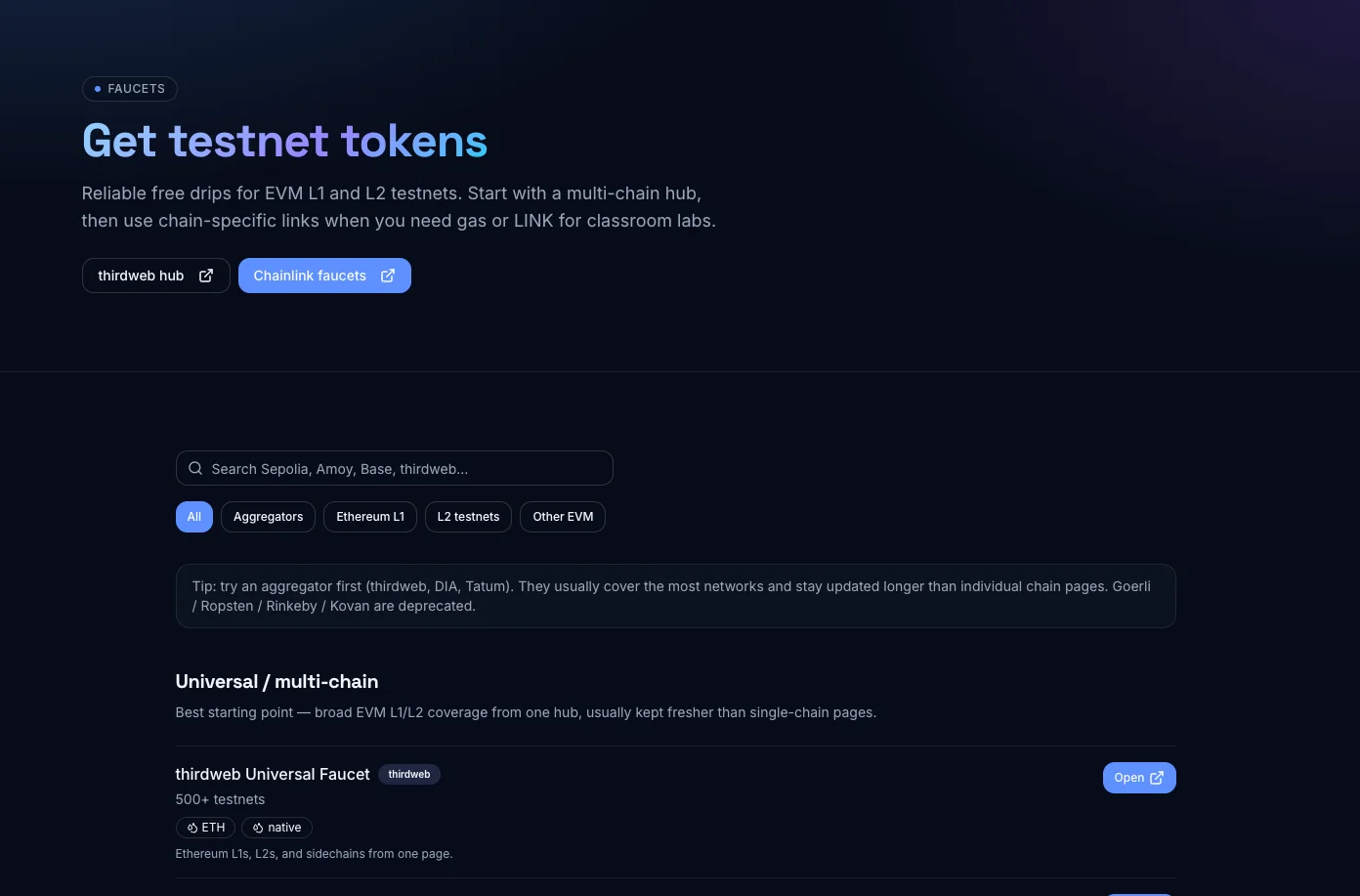
/faucets is a curated directory (Alchemy, QuickNode, Chainlink, Paradigm MultiFaucet, thirdweb, and chain-specific Sepolia/Amoy/Base links) for classroom and staging work.
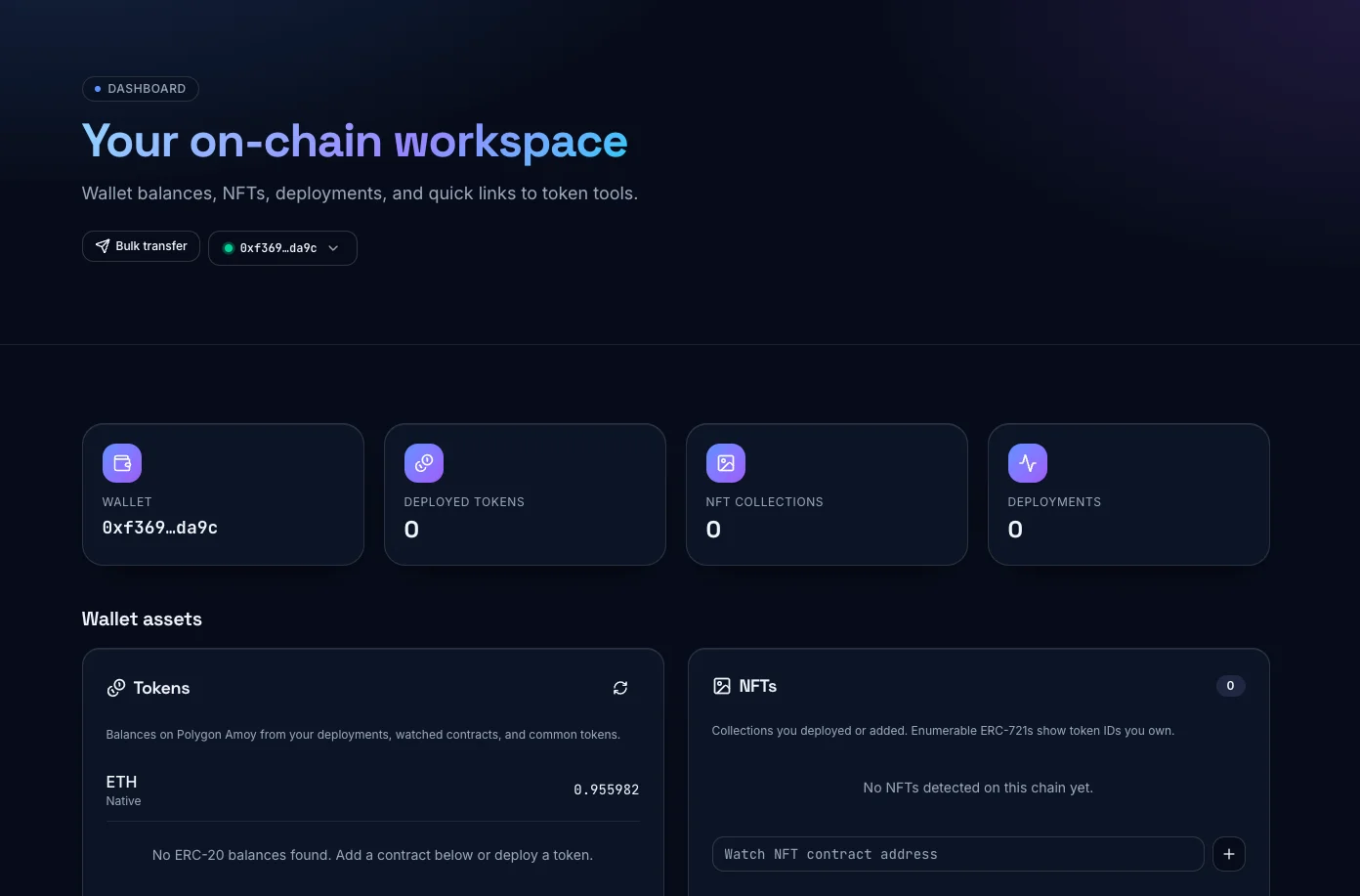
/dashboard is a wallet-gated workspace: token/NFT balances, watched contracts, deployment history, and jumps into bulk transfer / creators. Contract Manager lets you read/write contracts you deployed through the studio using local ABI history.
Learn + Guides
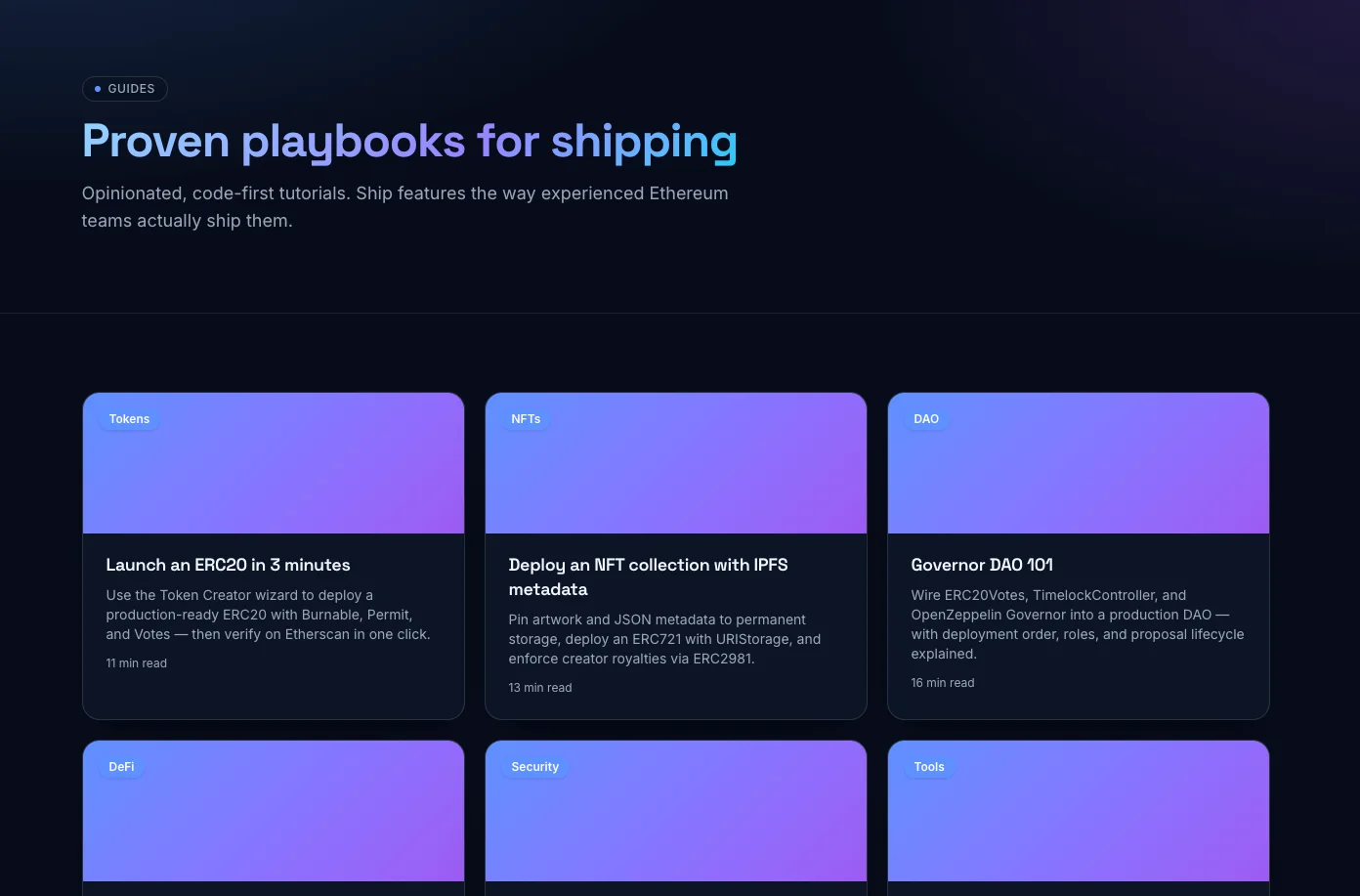
Education is not a separate blog you forget about. Fifteen Learn articles (Beginner → Advanced) cover wallets, gas/MEV, Etherscan, ERC standards, approvals, events, proxies, reentrancy, ERC-4337, and more. Seven Guides walk launch paths: ERC-20 in minutes, NFT + metadata, Governor DAO, staking, reentrancy checklist, Etherscan verify, and OpenZeppelin Skills locally.
There is also an OpenZeppelin Skills bridge for an agent-era workflow: draft in Ethereum Toolset → refine with OZ Skills in Claude Code / Skills CLI.
Architecture or Framework
The trust architecture is the product:
Audited by design: templates generate from OpenZeppelin sources (v5 / Contracts patterns). See the code: live Solidity preview before you sign. Compile in browser: no backend holding your source. Non-custodial: wallet signs deploy, Irys uploads, and transfers. Verify after ship: explorer / Sourcify path with Standard JSON. Education colocated: Learn + Guides open into the same wizards. Free to use: software marked price 0 — donate optionally in ETH/USDC if you want to support the builder.
Scale that is real today:
- 8 contract templates
- 14 developer tools
- 15 learn articles · 7 guides
- 35 networks (17 mainnets
- 18 testnets), including Ethereum, Polygon, Arbitrum, Optimism, Base, Avalanche, BNB, Linea, Scroll, Blast, zkSync, Gnosis, Mantle, Celo, Mode, Ink, Polygon zkEVM — plus Sepolia, Holesky, Hoodi, Amoy, and matching L2 sepolias
Wallets: MetaMask/injected, Coinbase Wallet, and WalletConnect when configured.
Ethereum Toolset sits in a multi-chain family with SolanaToolset and BNBToolset — same studio philosophy across ecosystems.
Benefits
For founders: ship a real ERC-20 / NFT / DAO without writing Solidity first, while still reviewing bytecode and constructor intent before signing.
For students and classrooms: faucet → testnet token → verified contract in one app, without juggling five browser tabs.
For developers: ABI, Merkle, CREATE2, and unit tools live next to the deploy wizards you already use.
For operators: holders export + bulk multi-send + downloadable reports turn “we minted a token” into “we can run an airdrop.”
For trust: OpenZeppelin patterns, client-side compile, wallet-signed deploys, and verification paths beat opaque mint factories.
For velocity: zero signup friction. Open the studio, connect a wallet, ship.
Challenges
A studio like this still has honest limits — and naming them builds more credibility than hiding them:
- Deployments and ABI history live in browser localStorage, not a hosted SaaS account system.
- NFT storage is Irys, not a classic IPFS pinning UI.
- The gas estimator is a rough calculator, not a live oracle.
- Bulk transfer deploys a helper contract on first batch use per chain.
- More automation can tempt people to skip review — the Solidity preview exists so you do not.
Those are product constraints, not marketing footnotes. The studio is free and non-custodial because it refuses to become a custodian of your keys or your source.
Future Opportunities
The next chapter of Ethereum developer tooling is agentic: draft contracts in a studio, refine with OpenZeppelin Skills in Claude Code / Skills CLI, then verify and operate with the same wallet-owned history.
Wider EVM coverage, deeper classroom paths (faucet → Sepolia → verified contract), and tighter airdrop ops (holders CSV → Merkle proofs → bulk transfer reports) are natural extensions of a studio that already refuses to be “just a mint button.”
If you are building across chains, the sibling toolsets (Solana / BNB) point at the same idea: one coherent place to learn, deploy, and ship — without surrendering custody.
Conclusion
Ethereum Toolset is for people who want a real studio: OpenZeppelin contracts you can see, browser compile you can trust, wallet signatures you control, and ops/education that continue after the deploy toast disappears.
Start at ethereumtoolset.com — connect a wallet, review the Solidity, and ship from classroom testnets to mainnet when you are ready.
Tagline: The Ethereum developer studio — deploy, build, and ship. Handle: @EthereumToolset
About the Builder
Muhammad Ibrahim (Ibrahim Wali) — Founder & CEO · Technology Architect · AI and Blockchain Builder.
Building technologies that empower businesses, communities, and future digital economies.
Building Today. Legacy Forever.
Ibrahim is the builder behind Ethereum Toolset, and also behind SolanaToolset and BNBToolset. His public knowledge libraries include:
| Library | Focus |
|---|---|
| ai-business-playbooks | Enterprise AI, agents, RAG, automation |
| blockchain-enterprise-blueprints | Tokenization, Web3, digital assets |
| founder-operating-system | Leadership, hiring, fundraising, scaling |
| future-of-ai-and-web3 | Decentralized AI, agent economies, research |
| 1000-startup-ideas | Startup opportunities across industries |
| system-design-for-founders | Architecture, cloud, scalability |
Product: ethereumtoolset.com
Read the full playbook on GitHub: https://github.com/Mibrahimwali/blockchain-enterprise-blueprints/blob/main/blueprints/2026/07/ethereum-toolset-developer-studio.md — part of our open knowledge library at https://irussoft.com/blogs.