
The challenge
When the engagement began in early 2023, South Africa had little technical precedent for real-world asset tokenization and its regulatory environment was still evolving. The client wanted to build an early platform that could bring traditionally off-chain assets into a digital investment workflow.
The software had to connect how assets were structured with how tokens were issued, held and transferred. It also needed to give investors and operators a way to work with different asset structures as requirements changed.
The solution
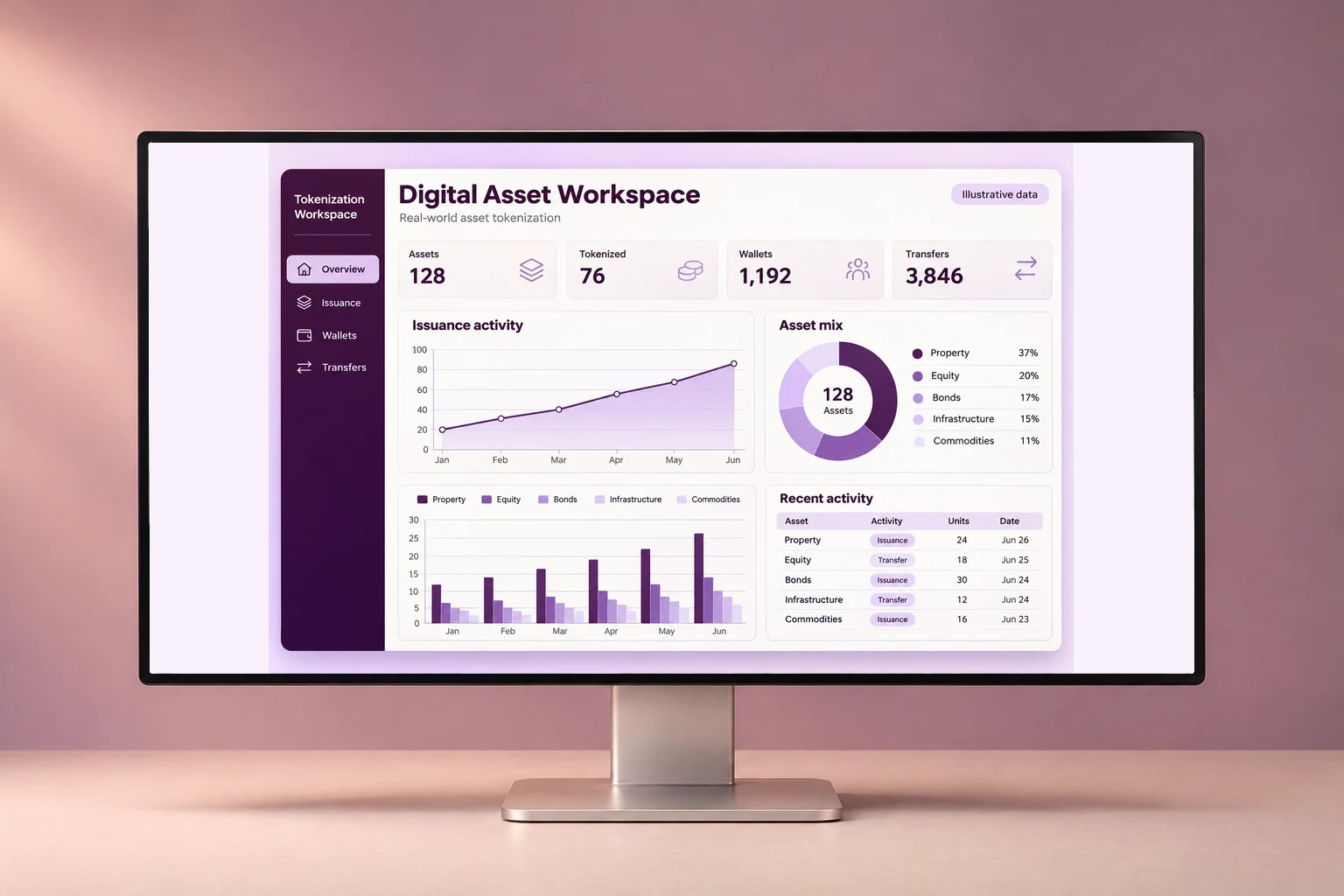
We built a modular platform spanning smart contracts, issuance and lifecycle workflows, wallet infrastructure, transaction management, investor interfaces and administrative controls. The same core system could support property, equity, bonds, infrastructure and commodities.
We worked alongside the client and its legal advisers, contributing technical input on how issuance, ownership and transfers could operate as the digital asset framework developed.
Our approach
We mapped the lifecycle from the underlying asset and legal structure through issuance, investor participation, transfers and ongoing management. Keeping the asset, its digital representation and the on-chain transaction record separate made it easier to adapt workflows for each asset class.
We designed wallets, smart contract interactions, transaction controls and administrative permissions around controlled access and auditable activity. Engineering and operational design progressed in parallel so the platform could move from concept into production.
The results
The client launched one of South Africa’s early production platforms for real-world asset tokenization. Its prospective pipeline expanded across five asset classes, and the shared architecture let the team assess more complex issuance opportunities without rebuilding the core platform for each one.
Key results
Prospective pipeline
$1B+Underlying asset value in the prospective tokenization pipeline. This figure represents potential opportunities; it does not measure assets issued or capital raised.
- Delivered infrastructure for token issuance, wallets, digital ownership and on-chain transfers.
- Supported fractional participation and issuance models across five asset classes.
- Built in controlled permissions and auditable activity so workflows could evolve with operational and regulatory requirements.
Technology & capabilities
- Smart contracts
- Token issuance
- Wallet infrastructure
- On-chain transactions