Introduction
Enterprise AI is moving from experimental chatbots to operational systems that handle high-value work inside legal, procurement, and sales teams. One of the strongest use cases is an AI Contract Review Assistant: a system that reads contracts, flags risky clauses, compares language against approved playbooks, and routes exceptions to the right reviewer.
For founders and technology leaders, this matters because contract review is repetitive, expensive, and slow. A well-designed assistant can reduce review time, improve consistency, and create a measurable control layer for business risk. Unlike generic document summarization, this use case requires precision, explainability, and a clear human approval workflow. That makes it a strong fit for Enterprise AI.
Problem Statement
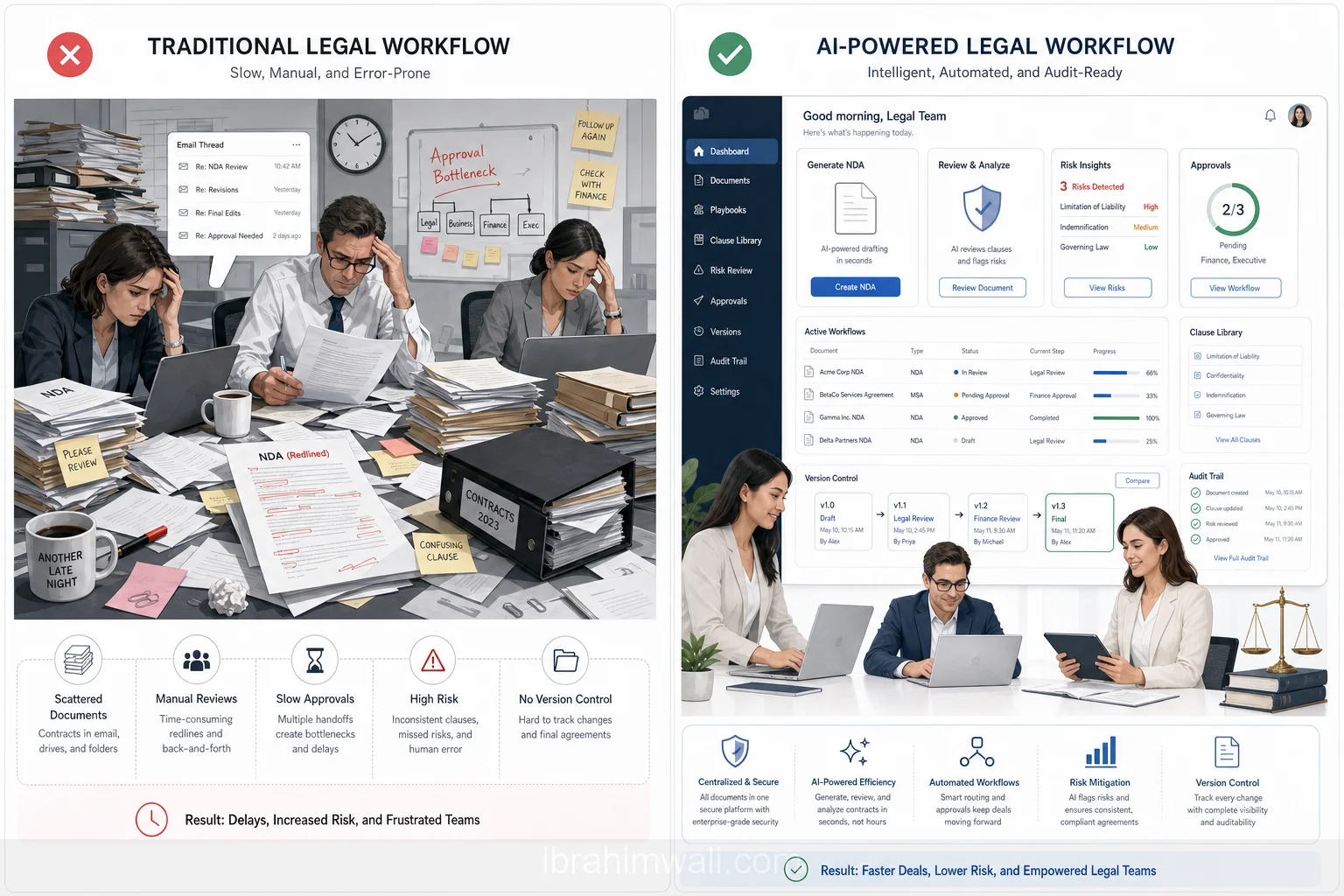
Contract review is full of patterns that are predictable enough for automation, but nuanced enough that simple rule engines fail.
Common pain points include:
- Sales teams waiting days for legal approval on standard agreements
- Legal teams spending time on low-risk redlines instead of high-risk exceptions
- Inconsistent clause interpretation across regions or business units
- Missed obligations buried in renewal, indemnity, liability, or termination language
- Lack of visibility into what was changed, why it changed, and who approved it
A manual process also creates operational bottlenecks. If every contract must be reviewed line by line, turnaround time grows with revenue. If the team shortcuts the process, risk increases. This is where Business Automation and Generative AI can help, but only if the system is designed around policy, not just text generation.
The core challenge is not “Can the model read a contract?” It is: can the system reliably identify deviations from approved language, explain the issue, and escalate only the cases that need human judgment?
Solution
An AI Contract Review Assistant should combine RAG with deterministic checks and human-in-the-loop approval.
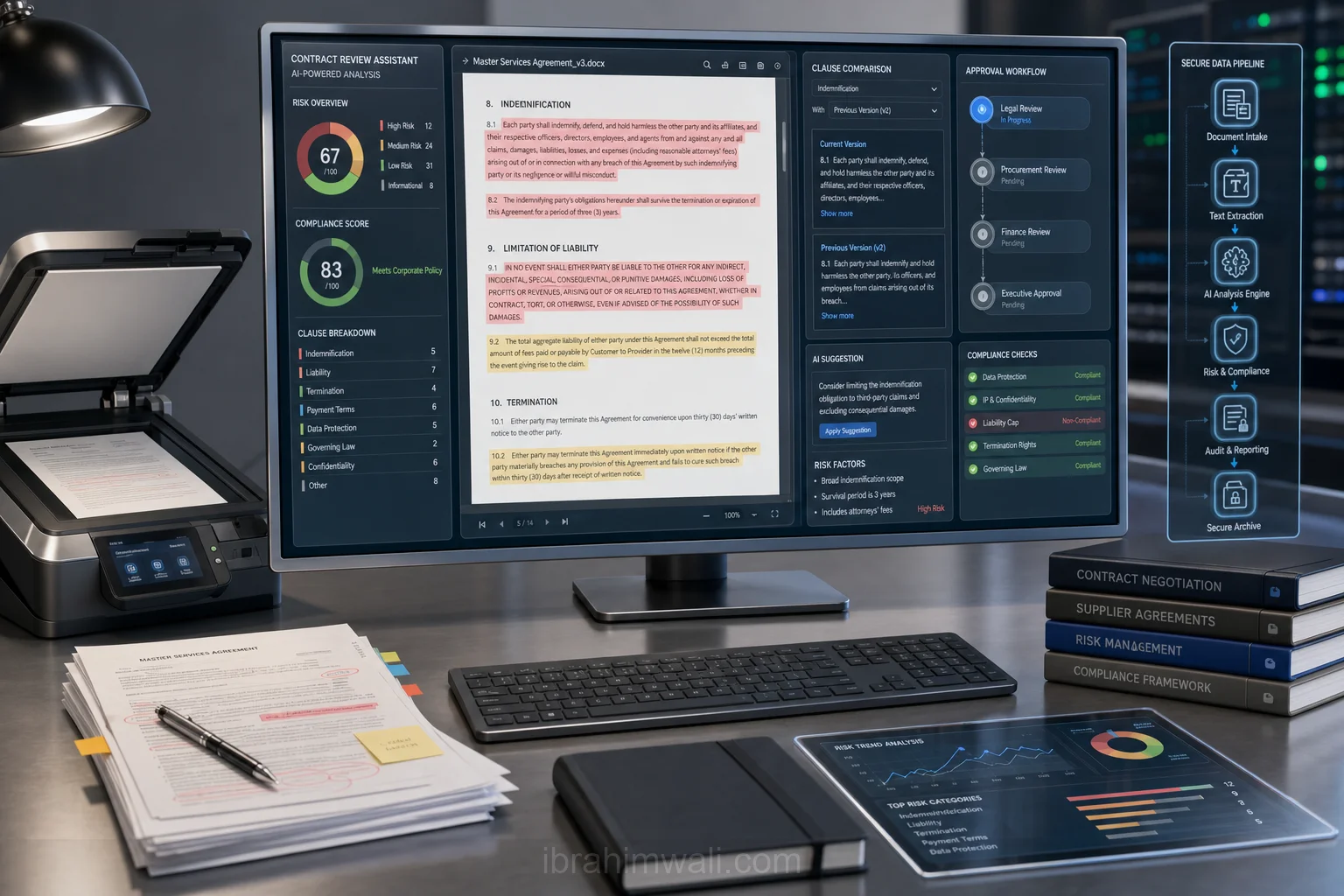
A practical solution includes these capabilities:
-
Document ingestion
- Accept DOCX, PDF, and clause libraries
- Extract text, preserve section structure, and detect tables and exhibits
- Normalize contracts by clause type and metadata
-
Clause classification
- Identify key clauses such as indemnity, limitation of liability, data processing, assignment, termination, and governing law
- Map extracted text to a contract taxonomy
- Detect missing clauses or unusual clause ordering
-
Policy comparison
- Compare contract language against approved fallback positions
- Flag deviations by severity: low, medium, high
- Show the exact sentence or clause that triggered the alert
-
RAG-assisted explanation
- Retrieve relevant internal playbook guidance, prior approved language, and policy notes
- Generate a concise explanation for the reviewer
- Provide citations to source documents so legal teams can validate the reasoning
-
Workflow routing
- Auto-approve low-risk contracts
- Route medium-risk items to a contract manager
- Escalate high-risk deviations to legal counsel
-
Audit trail
- Record model output, retrieved sources, reviewer actions, and final decision
- Keep versioned policy snapshots for compliance and traceability
The assistant should not replace legal judgment. It should reduce the amount of reading required and standardize first-pass analysis. That is the right role for Enterprise AI in regulated business processes.
Architecture or Framework
A reliable AI Contract Review Assistant works best as a layered system rather than a single model endpoint.
Recommended framework
1. Ingestion layer - Use OCR only when needed; native text extraction is more accurate for digital PDFs and DOCX files. - Preserve clause boundaries and headings. - Store document hashes for deduplication and auditability.
2. Retrieval layer - Index internal playbooks, fallback clause libraries, and approved redline examples in a vector store. - Chunk by clause, not by arbitrary token count. - Attach metadata such as jurisdiction, contract type, customer segment, and approval date.
3. Decision layer - Combine rules and model outputs. - Example rule: if liability cap is uncapped or exceeds policy threshold, mark as high risk. - Example model task: classify whether a clause is materially different from the approved fallback.
4. Generation layer - Use a constrained prompt that asks the model to summarize findings, cite retrieved policy text, and avoid legal advice language. - Require structured output: - clause name - risk level - deviation summary - recommended action - citations
5. Workflow layer - Integrate with CLM, ticketing, or approval tools such as ServiceNow, Jira, or Salesforce. - Support reviewer comments and decision overrides.
Operating model
A good framework is: Extract → Classify → Retrieve → Score → Explain → Escalate.
This sequence matters because it keeps the LLM out of the most brittle parts of the workflow. Deterministic parsing and rules handle structure and thresholds. RAG provides policy context. Generative AI produces the reviewer-friendly explanation. That separation improves accuracy and makes the system easier to audit.
Benefits
A well-implemented Enterprise AI contract assistant can produce measurable gains.
Faster review cycles Teams often cut first-pass review time by 40% to 70% on standard agreements. That is especially valuable for NDAs, MSAs, DPAs, and procurement templates.
Better consistency The assistant applies the same policy interpretation across reviewers, reducing variation caused by experience level or workload.
Higher legal throughput Legal teams spend more time on exceptions and negotiations instead of repetitive clause scanning.
Improved risk visibility Dashboards can show: - top recurring deviations - average time-to-approval - clauses most frequently escalated - business units generating the most exceptions
Stronger business automation The assistant can auto-route contracts, populate approval fields, and trigger downstream tasks such as redline requests or fallback clause insertion.
Better knowledge reuse Approved language and reviewer decisions become reusable organizational memory. Over time, the system becomes more accurate because it is grounded in the company’s own policy history.
Challenges
This use case is powerful, but it has real implementation risks.
Hallucination and overconfidence A model may produce a confident summary even when the clause is ambiguous. Mitigation: require citations, constrain output format, and use confidence thresholds.
Policy drift Fallback language changes over time. If the retrieval index is stale, the assistant may compare against outdated guidance. Mitigation: version policies and reindex on approval changes.
Poor document quality Scanned PDFs, handwritten edits, and messy formatting can break extraction. Mitigation: use OCR validation, layout-aware parsing, and exception handling for low-quality files.
Legal nuance Some clauses are acceptable only in specific jurisdictions or deal sizes. Mitigation: include metadata-aware rules and route edge cases to specialists.
Security and confidentiality Contracts contain sensitive commercial terms. Mitigation: encrypt documents at rest and in transit, restrict access by role, and avoid sending unnecessary content to external services.
Evaluation complexity Accuracy must be measured at multiple levels: - clause detection precision/recall - deviation classification accuracy - citation correctness - reviewer override rate - average time saved per contract
A strong pilot should not be judged only by “model quality.” It should be judged by business outcomes and risk reduction.
Future Opportunities
The next phase of Enterprise AI in contract review goes beyond clause spotting.
Negotiation copilots The assistant can suggest fallback language during live negotiations based on counterparty posture and prior deal history.
Cross-document reasoning Future systems can compare a contract against order forms, DPAs, security exhibits, and procurement policies to detect conflicts across documents.
Risk forecasting By analyzing historical approvals and deviations, the system can predict which customers, regions, or deal structures are likely to create negotiation friction.
Integration with enterprise systems A mature assistant can sync with CRM, CLM, ERP, and identity systems to auto-fill contract metadata and trigger approval logic.
Policy simulation Legal and operations leaders can test how a policy change would affect cycle time, approval volume, and risk exposure before rolling it out.
Agentic workflows With tighter controls, an AI agent could prepare a redline, draft an approval memo, and open a negotiation task automatically, while still requiring human sign-off before final release.
These opportunities are strongest when the organization has clean clause libraries, clear approval rules, and a disciplined governance model.
Conclusion
An AI Contract Review Assistant is a practical Enterprise AI application because it targets a high-friction workflow with clear rules, measurable outcomes, and strong business value. The best implementations do not rely on Generative AI alone. They combine RAG, rules, structured extraction, and human review to create a system that is accurate, explainable, and safe for enterprise use.
For founders and technology leaders, the key decision is not whether to automate contract review, but how to do it responsibly. Start with a narrow contract type, define the approved clause library, instrument every decision, and measure cycle time, escalation rate, and reviewer override rate. That approach turns contract review from a manual bottleneck into a controlled, scalable business process.
Read the full playbook on GitHub: https://github.com/Mibrahimwali/ai-business-playbooks/blob/main/playbooks/2026/10/ai-contract-review-assistant.md — part of our open knowledge library at https://irussoft.com/blogs.