Introduction
An AI Startup focused on legal document automation can solve one of the most repetitive, expensive, and error-prone workflows in modern business operations: creating, reviewing, and maintaining legal documents. Companies of all sizes need NDAs, MSAs, DPAs, employment agreements, vendor contracts, board consents, and policy updates. Yet most teams still rely on manual redlining, email threads, and outside counsel for routine work.
This creates a strong opportunity for founders building Enterprise SaaS products that reduce legal turnaround time, improve consistency, and lower cost. For a startup exploring SaaS Ideas with clear ROI, legal document automation is attractive because the buyer understands the pain, the workflow is frequent, and the measurable outcome is time saved. It also fits a broad set of Business Ideas across law firms, in-house legal teams, HR, procurement, and sales operations.
Problem Statement
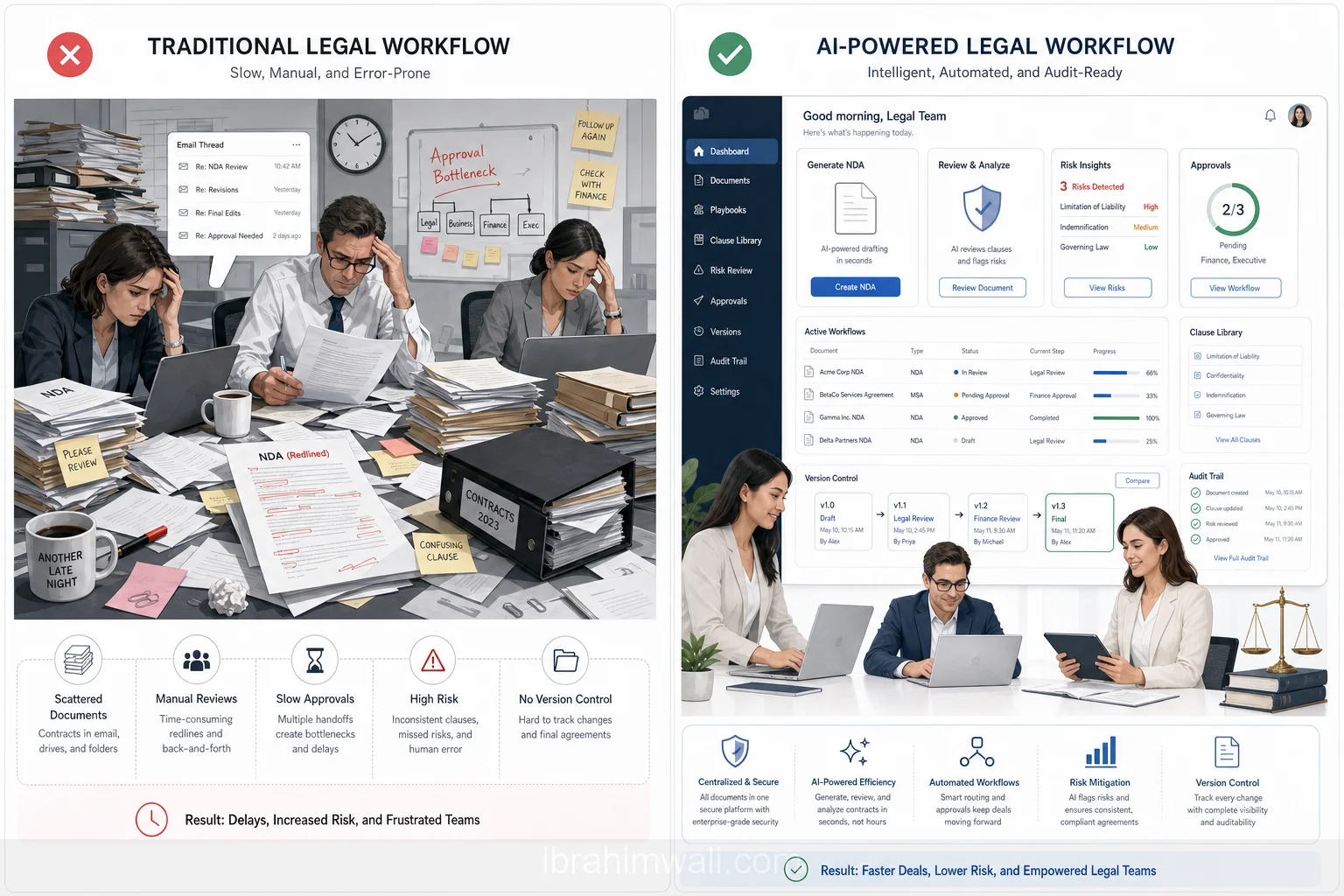
Legal document workflows are slow because they depend on human review for tasks that are often repetitive. A startup may need to generate the same NDA for 20 prospects, each with minor clause changes. A mid-market company may need to review dozens of vendor agreements with similar risk terms. A legal team may spend hours tracking obligations, signature status, and version changes across shared drives and email.
The main problems are:
- High legal cost: Outside counsel is expensive for routine document generation and review.
- Slow cycle times: Contract approval can delay revenue, hiring, and procurement.
- Inconsistent language: Teams use outdated templates or copy clauses from prior deals.
- Compliance risk: Missing clauses, incorrect jurisdiction language, or uncontrolled edits can create exposure.
- Poor visibility: Teams often lack a system of record for clause changes, approvals, and obligations.
For founders, the opportunity is not to replace lawyers. It is to automate the repetitive 80% of work while escalating the 20% that requires expert judgment. That positioning is especially strong for an AI Startup targeting legal operations, where trust, auditability, and workflow control matter more than flashy automation.
Solution
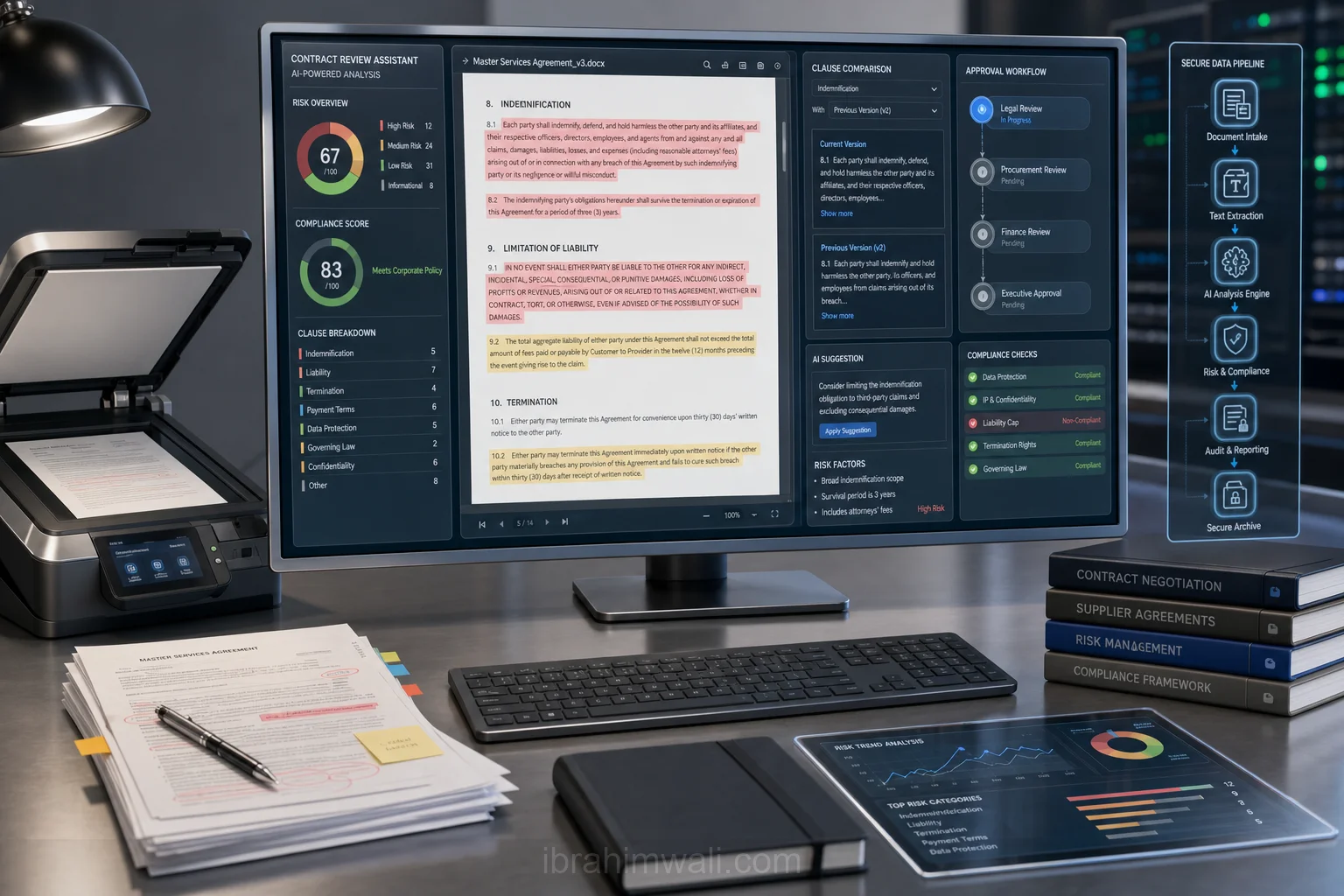
The product should combine document generation, clause intelligence, and review workflows into a single system. A practical MVP should focus on one narrow use case first, such as NDA generation or vendor contract review, then expand into adjacent documents.
A strong solution includes:
-
Template-based document generation
- Users select a document type, fill a guided form, and generate a first draft.
- The system uses approved clause libraries and jurisdiction-specific variants.
- Legal teams can lock sections that should never be edited.
-
AI-assisted review
- The system identifies risky, missing, or non-standard clauses.
- It compares incoming documents against company playbooks.
- It highlights deviations such as liability caps, indemnity language, payment terms, or auto-renewal clauses.
-
Clause extraction and metadata tagging
- The platform extracts contract parties, effective dates, renewal terms, termination windows, and governing law.
- This supports search, reporting, and obligation management.
-
Approval workflows
- Documents route to the right reviewer based on value, risk level, or contract type.
- Low-risk agreements can auto-approve under policy thresholds.
- High-risk items escalate to legal counsel.
-
Audit trail and version control
- Every change, suggestion, and approval is logged.
- This is critical for compliance and enterprise buyers.
A useful MVP strategy is to target one buyer persona. For example, sales-led SaaS companies often need fast NDAs and MSAs. HR teams need employment and contractor agreements. Procurement teams need vendor contract review. Each segment can become a wedge into a larger Enterprise SaaS platform.
Architecture or Framework
A reliable AI legal document automation product should use a hybrid architecture: deterministic rules for compliance-critical logic and LLMs for language understanding and drafting assistance.
Recommended framework components
- Front end: React or Next.js for guided workflows and document review UI.
- Backend API: Node.js, Python FastAPI, or Go for workflow orchestration.
- Document parsing: OCR and text extraction for PDFs, DOCX parsing, and table recognition.
- LLM layer: Used for clause summarization, redline suggestions, and plain-language explanations.
- Rules engine: Encodes company policy, fallback clauses, and approval thresholds.
- Vector search: Stores clause embeddings for semantic retrieval of prior agreements and playbooks.
- Database: PostgreSQL for structured metadata and audit logs.
- Object storage: Secure storage for original files and generated versions.
Key design principle
Do not let the model make final legal decisions on its own. Instead, use AI to propose, classify, and explain. Use rules and human approvals to decide. That separation improves trust and reduces liability.
Security and compliance requirements
Because this product handles sensitive legal data, the architecture should include:
- Encryption at rest and in transit
- Role-based access control
- Tenant isolation for multi-tenant deployments
- Data retention policies
- Redaction for sensitive fields
- SOC 2 readiness from early stages
For a startup, this architecture supports an incremental roadmap: start with document generation, add review intelligence, then expand into contract lifecycle management.
Benefits
The business case for AI legal document automation is strong because the value is measurable.
For customers
- Faster turnaround: Reduce contract cycles from days to hours.
- Lower legal spend: Cut repetitive outside counsel work.
- Better consistency: Standardize approved language across teams.
- Reduced risk: Catch non-standard clauses before signatures.
- Improved visibility: Track obligations, expiration dates, and approvals in one place.
For the startup
- Clear ROI narrative: Time saved and legal cost reduction are easy to sell.
- Sticky workflows: Once legal templates and playbooks are configured, switching costs rise.
- Expansion potential: Start with one document type and expand into a broader platform.
- Multiple buyer paths: Sell to legal, sales ops, HR, procurement, or founders.
- Strong recurring revenue: This is well suited for subscription-based Business Ideas with usage-based add-ons.
For product-market fit
This category has a natural path to product-market fit because the pain is frequent, the buyer is identifiable, and the outcome is easy to measure. Useful metrics include:
- Average contract turnaround time
- Percentage of documents auto-generated without manual edits
- Number of clause deviations detected
- Reduction in outside counsel hours
- Approval SLA compliance rate
Challenges
This is a promising market, but it is not easy. Legal users are cautious, and enterprise buyers require trust.
- Hallucinations and legal accuracy
LLMs can generate plausible but incorrect language. That is unacceptable in legal workflows. The product must constrain generation with approved templates, retrieval from vetted clauses, and validation rules.
- Trust and adoption
Lawyers and legal ops teams need explainability. If the system flags a clause as risky, it should show why, reference the policy, and link to the relevant playbook rule. Black-box recommendations will slow adoption.
- Data privacy and security
Legal documents often contain confidential financial terms, employment issues, and personal data. A startup must invest early in security architecture, tenant isolation, and access controls.
- Complex edge cases
Contracts vary by jurisdiction, industry, counterparty size, and negotiation history. A narrow MVP is essential. Trying to support every contract type too early will create product complexity without a clear revenue path.
- Long enterprise sales cycles
If the product targets larger organizations, sales cycles may be slow. Founders should consider a bottom-up entry point, such as self-serve NDA generation or clause review for startup legal teams, before moving upmarket.
Future Opportunities
The long-term opportunity goes beyond document automation. Once the platform becomes the system of record for legal language and approvals, several expansion paths open up.
- Contract intelligence and analytics
The startup can analyze clause trends across all agreements and surface risk patterns by vendor, customer segment, or jurisdiction. This turns legal data into decision support.
- Cross-functional workflow automation
Legal documents touch sales, HR, finance, and procurement. The platform can expand into approval routing, signature coordination, and post-signature obligation tracking.
- Vertical-specific products
A focused AI Startup can build specialized versions for healthcare, fintech, real estate, or SaaS companies. Each vertical has distinct clauses, compliance needs, and document flows.
- Agent-assisted negotiation
Future versions may propose fallback positions during negotiations, suggest acceptable redlines, and prepare summary briefs for legal review. This should remain assistive, not autonomous.
- Integrations ecosystem
High-value integrations include DocuSign, Microsoft Word, Google Drive, Salesforce, Slack, and contract repositories. Integrations increase retention and make the product part of daily operations.
For founders scanning SaaS Ideas, this category stands out because it combines recurring pain, clear monetization, and expansion potential. It is one of the more practical Enterprise SaaS opportunities for teams that can balance AI capability with legal-grade controls.
Conclusion
AI legal document automation is a compelling startup opportunity because it addresses a costly, repetitive workflow with measurable business value. The best products will not try to replace legal judgment. Instead, they will combine LLMs, rules engines, and approval workflows to make routine legal work faster, safer, and more consistent.
For founders, the winning strategy is to start narrow, build trust through auditability, and expand into adjacent contract workflows after proving value. If executed well, this can become a durable AI Startup with strong retention, clear ROI, and a natural path into broader enterprise operations.
Read the full playbook on GitHub: https://github.com/Mibrahimwali/1000-startup-ideas/blob/main/ideas/2026/08/ai-legal-document-automation.md — part of our open knowledge library at https://irussoft.com/blogs.