Introduction
Blockchain Startups are often strongest when they solve a trust problem that traditional software cannot. A Blockchain Loyalty Engine is a startup concept that uses blockchain to issue, track, and redeem loyalty points across multiple merchants without relying on a single company’s closed database. For founders exploring Startup Ideas, this is a practical category because loyalty programs already have clear demand, measurable economics, and recurring usage.
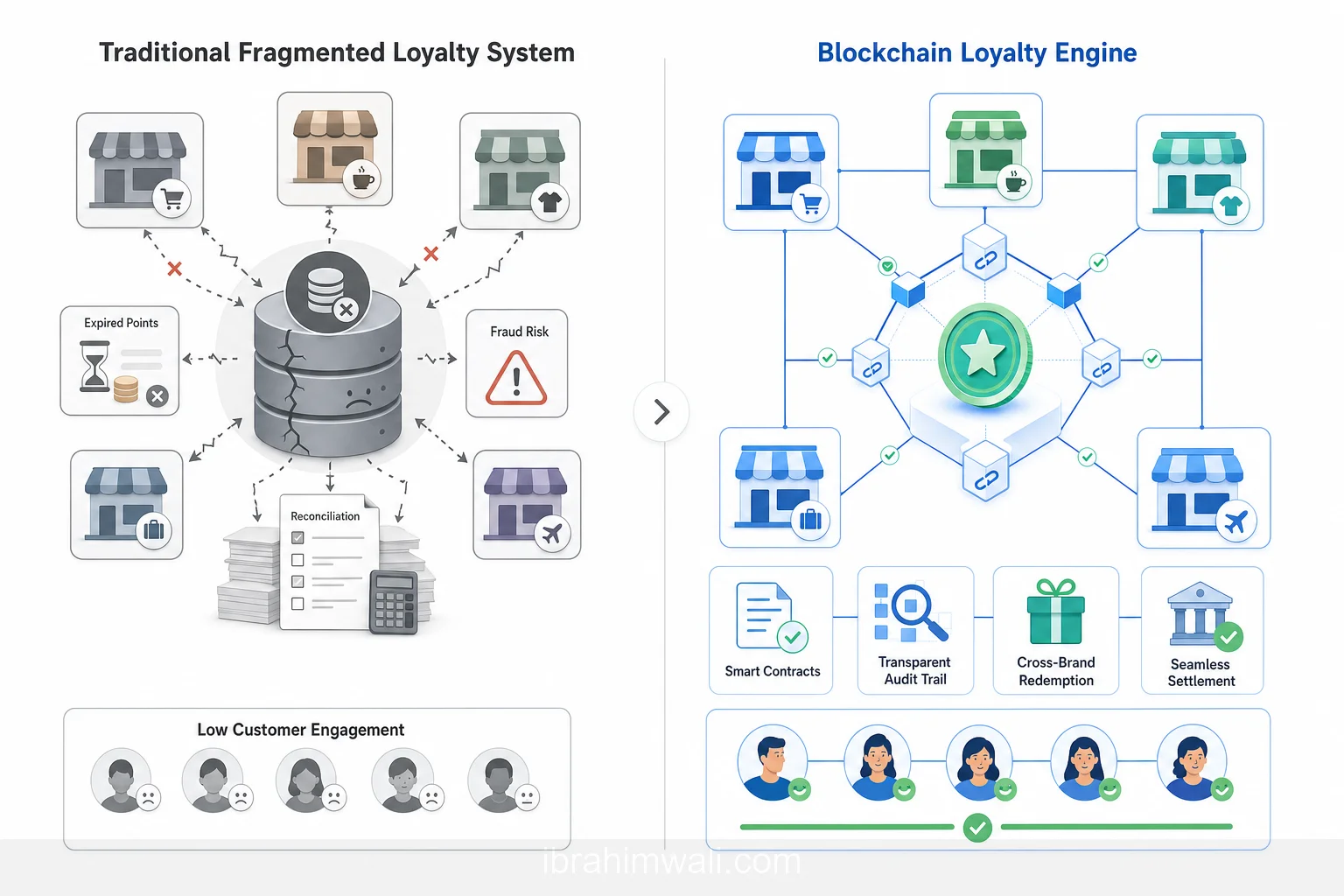
Traditional loyalty systems are fragmented. Customers earn points in one store, lose value when programs expire, and rarely transfer rewards between brands. Merchants, meanwhile, struggle with fraud, poor interoperability, and low redemption rates. A blockchain-based loyalty platform can address these issues by making rewards portable, auditable, and programmable. For SaaS founders, this creates a strong SaaS Ideas opportunity: sell a loyalty infrastructure layer to brands, marketplaces, and consumer apps.
The key innovation is not “putting points on-chain” for novelty. The real value is creating a shared settlement and redemption layer that reduces administrative overhead, improves partner collaboration, and increases customer retention.
Problem Statement
Conventional loyalty programs have four recurring problems:
-
Siloed points systems Each merchant runs its own ledger, which prevents cross-brand redemption and makes partnerships expensive to manage.
-
Fraud and reconciliation issues Points can be duplicated, manipulated, or misreported when systems are centralized and poorly audited.
-
Low customer engagement Customers often ignore points because redemption is inconvenient, expiration is confusing, and rewards feel disconnected from real value.
-
High integration cost Brands want loyalty features, but building a custom rewards engine, partner network, and settlement process is costly.
These issues create an opening for Blockchain Startups that can provide a shared loyalty infrastructure. The opportunity is especially attractive for mid-market retail, hospitality, fintech, and consumer apps that want a modern rewards system without building a proprietary platform from scratch.
Solution
A Blockchain Loyalty Engine is a SaaS platform that lets merchants issue digital rewards, define redemption rules, and settle value through smart contracts or tokenized accounting.
Core capabilities should include:
- Tokenized points issuance: rewards are minted when a customer completes a qualifying action.
- Cross-merchant redemption: points can be used across participating brands based on configurable exchange rates.
- Programmable expiration and vesting: points can expire, unlock in stages, or require minimum activity.
- Fraud-resistant audit trail: every issuance and redemption is recorded immutably.
- Partner settlement: merchants can reconcile liabilities and reward costs automatically.
A strong MVP should focus on one narrow use case, such as: - restaurant groups with multi-location rewards, - e-commerce marketplaces with partner discounts, - fintech apps offering cashback-like loyalty tokens, - travel or hospitality alliances.
The business model can be straightforward: - monthly SaaS fee, - transaction fee per issuance/redemption, - premium analytics and partner-network features, - enterprise onboarding and custom integrations.
This is one of the more commercially realistic Innovation opportunities in blockchain because it combines a known business process with a technical trust layer, rather than requiring consumers to adopt a speculative asset.
Architecture or Framework
A practical blockchain loyalty architecture should separate the user-facing experience from the settlement layer. Most interactions should remain fast and cheap, with blockchain used where trust, portability, and auditability matter.
Recommended framework
1. Off-chain event processing - Capture purchases, referrals, and engagement events in a standard event store. - Validate eligibility before minting rewards. - Use queue-based processing to avoid double issuance.
2. Smart contract layer - Use a token standard or custom contract to represent loyalty points. - Encode issuance caps, redemption permissions, and partner rules. - Keep contract logic minimal to reduce gas costs and security risk.
3. Wallet and identity layer - Support custodial wallets for mainstream users and non-custodial wallets for advanced users. - Use email, phone, or embedded wallet onboarding to reduce friction. - Map customer identity to wallet addresses through a secure identity service.
4. Merchant admin and analytics - Provide dashboards for liabilities, redemption rates, cohort retention, and partner performance. - Expose APIs and webhooks for POS, e-commerce, and CRM integrations.
Implementation stack
A founder-friendly stack might include: - Backend: Node.js or Go - Database: PostgreSQL for off-chain records - Queue: Kafka or SQS - Blockchain: Polygon, Base, or another low-fee EVM chain - Contracts: Solidity - Wallets: embedded wallet provider or account abstraction - Analytics: Metabase, dbt, or a warehouse like BigQuery
Metrics to track
A serious Blockchain Loyalty Engine should measure: - redemption rate, - repeat purchase rate, - fraud rate, - average points liability, - partner activation time, - cost per active member, - monthly active wallets, - reward breakage percentage.
These metrics determine whether the product is creating real economic value or simply moving points onto a blockchain.
Benefits
A well-designed blockchain loyalty platform offers several concrete advantages.
For merchants - Lower reconciliation overhead - Better partner collaboration - Transparent reward liabilities - Easier expansion into multi-brand programs
For customers - Portable rewards - Clearer ownership of points - Faster redemption across merchants - Better perceived value of loyalty participation
For founders - Clear SaaS monetization - Enterprise and SMB entry points - Strong retention once integrated - A differentiated position among Startup Ideas in fintech and commerce infrastructure
For the ecosystem - More interoperable rewards networks - Better auditability for promotions - New partnership models between brands - A foundation for tokenized membership, referrals, and community incentives
This is why the concept stands out among SaaS Ideas: it can become a sticky infrastructure product with recurring revenue, while still being narrow enough to launch with a focused pilot.
Challenges
Despite the opportunity, blockchain loyalty is not trivial to execute.
-
User experience friction Most customers do not want to manage wallets, seed phrases, or gas fees. If onboarding feels crypto-native, adoption will suffer. The product must feel like a normal loyalty app with blockchain hidden in the background.
-
Regulatory and accounting complexity Tokenized rewards can raise questions about stored value, securities treatment, tax reporting, and consumer protection. Founders need legal review early, especially if points are transferable or cash-equivalent.
-
Merchant network effects A loyalty engine becomes more valuable as more merchants join, but the first few integrations are hard. The startup must solve the cold-start problem with a compelling anchor customer or niche vertical.
-
Security and smart contract risk Contracts that control issuance and redemption are high-value targets. Audits, permission controls, and rate limits are mandatory. A bug in reward logic can create direct financial loss.
-
Economics of on-chain usage If every redemption is written on-chain, fees and latency can become a problem. Many startups will need a hybrid model where only final settlement or high-trust events go on-chain.
The best founders in Blockchain Startups will treat these challenges as product constraints, not afterthoughts.
Future Opportunities
The Blockchain Loyalty Engine can expand beyond points into a broader incentive infrastructure.
Multi-brand loyalty networks Retailers, restaurants, and service providers could form shared reward ecosystems where points work across a category or region.
Tokenized memberships Instead of simple points, customers could hold access passes that unlock perks, early drops, or premium support.
AI-driven personalization Loyalty data can power recommendation engines that tailor offers by customer behavior, spend patterns, and redemption history.
Embedded fintech The platform can evolve into a rewards wallet that supports cashback, installment incentives, and merchant-funded promotions.
B2B2C infrastructure A white-label loyalty layer can be sold to agencies, SaaS platforms, and commerce tools that want to add rewards without building native systems.
For founders evaluating Innovation opportunities, this category has room for both vertical SaaS and horizontal infrastructure. The winning version will likely combine embedded wallets, partner settlement, and analytics into one operational platform.
Conclusion
A Blockchain Loyalty Engine is a strong startup concept because it solves a real business problem: fragmented, inefficient, and hard-to-trust loyalty systems. For founders exploring Blockchain Startups, it offers a practical path into commerce infrastructure with clear monetization, measurable outcomes, and room for network effects.
The best approach is to avoid overengineering the blockchain layer. Start with one vertical, one redemption model, and one merchant workflow. Prove that the system improves retention, reduces reconciliation work, and increases redemption. If those metrics move, the product can expand into a broader loyalty network and become a durable SaaS business.
Among modern Startup Ideas, this one stands out because it blends operational utility with long-term platform potential. It is not just a token project; it is a loyalty operating system for the next generation of merchants and consumer brands.
Read the full playbook on GitHub: https://github.com/Mibrahimwali/1000-startup-ideas/blob/main/ideas/2026/07/blockchain-loyalty-engine.md — part of our open knowledge library at https://irussoft.com/blogs.